
2026/2027 SEASON ANNOUNCEMENT
Hello Modern Archaics!
We are more than excited to show our second full season with you guys. This one is shaping up to be our best yet.
This season we wanted to explore plays that prominently featured jealously and the misunderstanding or miscommunication that usually causes it. We’ve found that what makes these classic plays timely is when they touch on feelings that are undeniably human.
We chewed on several plays but really it came down to what they had to say about each other and cultivating a narrative throughout the season that would be satisfying for people who choose to see every show, but just as satisfying to those who see just one part of our season.

So, our season started with a Post Apocalyptic version of The Bacchae, set in a world just
barely recovering from some nuclear holocaust.
This concept allowed us to keep a, nearly, three thousand year old piece timely, while still allowing us to be true to the headspace of the people and technology afforded to the Greeks of then.
This play, on the surface, is about a god coming down to show the blasphemer how wrong he is—but in working on The Bacchae we discovered a plethora of nuance (as is often the case working with these plays).
One of them:
We found that, actually, Dionysus is jealous of Pentheus just as much as Pentheus is jealous of Dionysus. They want what the other has. Pentheus grew up with a mother, a family; Dionysus grew up with a kind of absolute power and respect.
It’s a tragedy because they probably would have been friends, they probably could have taught each other something about what the other has, but instead only death and violence ensued, as Greek plays usually bring.

Now, looking at our next show:
The Winter’s Tale by William Shakespeare
This play follows the events of the self inflicted madness called jealousy.
Leontes, King of Silica, for no reason, at all, falls under the spell of jealousy and believes he sees signs where there aren’t that his faithful wife Hermione and his lifelong best friend, King of Bohemia Polixines, are having an affair.
Leontes explodes his life (and many others’) over a silly idea he conjured up all on his own.
This play speaks to the effects that this natural, human emotion can have on not only your life but others’ especially when the person suffering it is a king (or something like it…).
This play, once the climax of self-destruction has reached its peak, for one act, the play completely switches protagonists and jumps 16 years into the future, following Leontes’ baby daughter, born shortly before the climax, and subsequently sentenced to death by him (and obviously survives); we, then, see how she’s grown and is brought back to Sicilia.
It is as a result of her return, that Leontes can be forgiven, forgive himself, and carry on the rest of his life a better man.
I find the following generation being the catalyst that evokes this change to be a fascinating theme that often recurs in many of these classic works; it exhibits a metaphor for age repeated over and over in this old plays: that while the old age tempers the natural madness of youth, educating and reminding them of the past; the youth, then, forces the old to change because they have the eyes to see and the youthful stamina to try and do something about it.

The following play, sort of diverges from the theme of jealousy, there’s an argument to be made for it, but it’s more a fun Holiday-adjacent play that we’d like to keep up as a yearly tradition than anything else.
It’s a home-grown play based on a piece of Ukrainian folklore following an imp called Chort who wants to ruin one particular guy (Vakula)’s life and, due to his own incompetence, fails!
The book we based the story on was written as a mask to cover up a plot within the center.
Vakula, tasked by his love, goes to Katherine The Great’s palace to get her shoes, and while he’s there, he meets a couple of Cossacks on a diplomatic mission to prevent Russia from attacking their lands. These Cossacks were pivotal to the various other campaigns Russia, of the time, successfully won, and after this mission, in real life, Russia killed them all and outlawed the very existence of this culture.
Mykola Gogol wrote this novella to show this one kernel of historical truth, in an other wise silly narrative.
And, due to the immediate relevance and underrepresented Ukrainian’s that live in our country not having much media FOR them, we present, for the second time:
Chort; The Night Before Christmas in Dykanka!
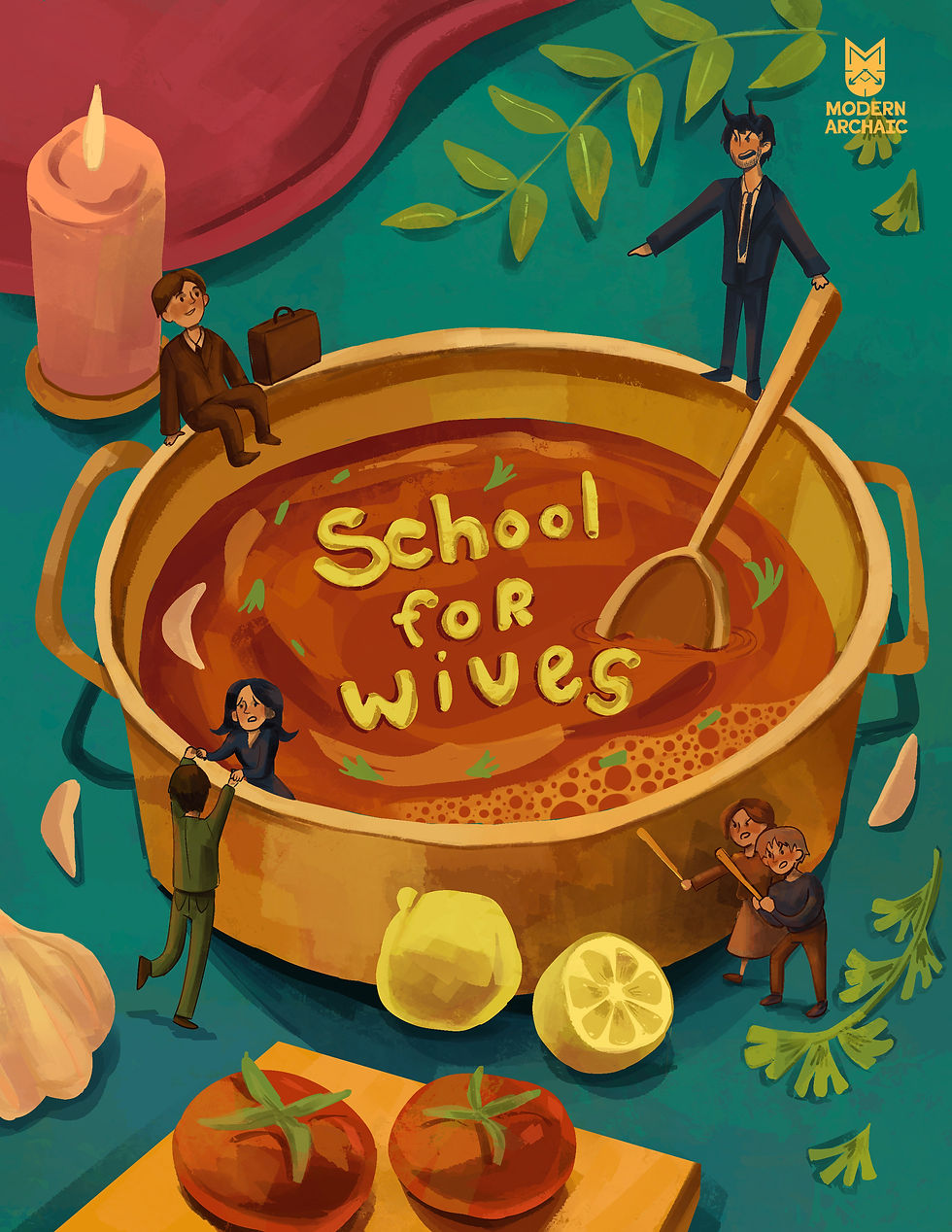
Picking up with the next play and building from where we left off on with The Winter’s Tale, we move to Moliere’s The School for Wives.
This play follows a wealthy, 42-year-old man named Arnolphe who has groomed his young ward, effectively his daughter, Agnes, who he raised since she was 4, to be his ideal wife (an ignorant, dumb, obedient loyal only to him).
He has concocted this vile scheme to prevent his greatest fear from coming true: His wife cheating on him. Throughout the events of the play, this fear, which is driven by a kind of jealousy, drives him to bring it closer to it becoming a reality.
Spoiler alert: He, of course, does not marry this 18-year-old and his diluted form of love is never realized, because it’s selfish, impersonal, and pathetic—Arnolphe is a twisted man who we should laugh at.
We see things like this every day—rich men marrying, dating, being with young adults simply because of wealth and it’s plainly unacceptable.
This play, even when it was written, faced much criticism for it being “amoral,” but what is amoral about it?
Really, I think, it was a public outcry of men, like Arnolphe, wealthy and powerful, upset that they were being laughed at by the general public.
Moliere has a long history of ruffling feathers, but in these particular feathers could use some more ruffling, we think.

The final play is probably the most well known on our list: Much Ado About Nothing by William Shakespeare
A professor once told me the play might have been called “Much Ado about Noting” because if just one of the characters would think a bit about where their information is coming from, they might see some flat tomfoolery is a foot.
But, I like “Much Ado about Nothing” as a title more—because what is the conflict about? A lot of people miscommunicating and, therefore, arguing about nothing.
It’s actually the reason it’s the largest word on our poster.
Claudio, jealous in his humors, perhaps, is so easily duped by Don John (the evil brother of Don Pedro who recently failed to stage a coup!) and, foolishly, never fact checks anything, letting his emotions run ahead of his head.
First, he believes Don Pedro has wooed his love, Hero, for himself rather than for Claudio; then he believes she’s cheating on him with a cup bearer, who is in a sexual relationship with her maid. Neither time does he check with the people involved before reacting (exploding, really!)
Similarly, Beatrice and Benedick, obviously still love each other (despite whatever caused their first break up) but instead of communicating that with each other, working out their issues, they bicker.
It isn’t until they “hear” about the other person talking to someone else about their feelings and hear that their flaws are the problem, that they decide to embrace their feelings and work on their flaws.
I mean, if you want to talk about modern dating? This is it!
And, while there is something relatable about losing your head over a girl in a new relationship or, because you aren’t allowed to be with someone, fighting with them so at least your able to connect—the true moral of the play is change and communication are keys to success in this life!
I think this play is so fascinating because our main characters, if it were any other Shakespeare play, would be the B plot.
I mean, on the surface, it’s just two stubborn people getting pranked into admitting their feelings.
You would think Claudio and Hero and their tumultuous engagement would be the main plot. Literally everything in this play is related to their wedding, but, instead we watch two normal people, who love the people getting married, change and through these events of the play as they learn what’s really important.
And it’s not pride.
They learn love each other because this experience they’ve shared has shown who they really are to, not only each other, but themselves.
Obviously, the jealousy theme is related to Claudio not being able to stand the idea of Hero being with anyone else—but this play is really about fact checking, talking to each other, being reasonable, and change.
It’s a comedy because everyone fails to do that!
But, hey, that’s our season! I hope you appreciate the narrative, can see the conversation between the plays, and are excited to see these up on their feet.
Best wishes,
Jesse James Hoover
Artistic Director of Modern Archaic Theatre Company

Comments